
You have heard this dozens of times: social media is a drug. While it doesn’t literally kill you, it makes your life significantly worse by giving you small doses of effortless gratification, narrowing your attention span and keeping you from getting big doses of effortful gratification.
Most videos, podcasts and articles stop here — but nobody explains how to quit it, exactly. If you’ve ever tried quitting anything even slightly addictive, you know it’s a tough battle. Your brain switches into negotiation mode, where it’s constantly comparing the value of “staying clean” to the value of “relapsing”. Eventually one side wins (usually the latter).
Going cold turkey
You probably already know it doesn’t work for you if you’re still reading this article :—).
Going cold turkey seems like a super straightforward solution — just decide to quit, stop reading social media, delete the apps, and when your girlfriend sends you an Instagram reel with cute kittens, yell “NO! I’M NOT FALLING FOR THIS!”
Guess what? Our brains are so hooked they will always find ways to hack the system.
You will reinstall the app. You will use the web version. You will promise yourself to scroll the feed for only 15 minutes and you won’t keep that promise. You will start with just a glance and then find yourself spiraling down the YouTube recommendations.
And it’s not that one day you say “fuck it” and immediately go back to square one. You may run on pure willpower for some time, but without fundamental changes your strategy starts to steadily degrade through minor slips, cheats and loopholes in your own rules.
When I realized this, I decided to try out a new strategy, for which I’d found a pretty unconventional source of inspiration.
The Russian Method
It’s not called that because I’m Russian. It’s just a strategy that the Russian government has been continuously using on its citizens for decades.
Let’s look at the current state of the internet in Russia: all the foreign social media (and thousands of other websites) are blocked, all independent journalists are exiled or imprisoned, and the government is constantly fighting VPN services as people find more exotic ways to get around the blocks.
It didn’t happen overnight, right? If it had happened the day after the 2012 presidential election, people would have rebelled hard and maybe overthrown the government. What was unimaginable fifteen years ago now doesn’t even make the news.
The Kremlin is tightening the screws so slowly that people’s brains have enough time to adapt. Whenever a government does something suddenly (e.g. starting a war, initiating a military mobilization), it faces a huge backlash, takes a reputational hit and tries not to make the same “mistake” again.
As cruel as it may sound, I decided to be my own Russian government. Instead of quitting abruptly, I gradually imposed small restrictions on myself that created artificial friction in my daily life and thus raised the barrier to the gratification.
Adding friction
I started by making social media much less convenient to use, with no hard restrictions at that point.
I deleted the Twitter, TikTok and Facebook apps from my phone, but still let myself visit them in my mobile/desktop web browsers. For the other apps I need, I installed a guard that requires some effort from you before opening the app itself. For example, I’m required to follow a circle with my finger for three seconds before I’m allowed into Instagram.
For web browsers, a quirky solution for me was installing an extension that keeps certain websites out of my browser history. Every time I want to visit Twitter I have to type the full address instead of just pressing t→enter. (I still call it Twitter, so x-dot-com doesn’t exist in my head.)
Lastly, I decided that I should only have one way to visit each social network. So I enabled parental controls and blocked Twitter on my phone and Instagram on my laptop. Sometimes I suddenly remember there’s a Twitter mobile app! And it can send you notifications, brrr.
I lived with this setup for a couple months before I felt I was ready for the next move.
Hard restrictions
After I fully adapted to the new setup, I decided I needed to cut down on the time I was spending on social media. My friend here is a Chrome extension that allows you to set time limits for certain websites, and once the time runs out you hit a hard wall.
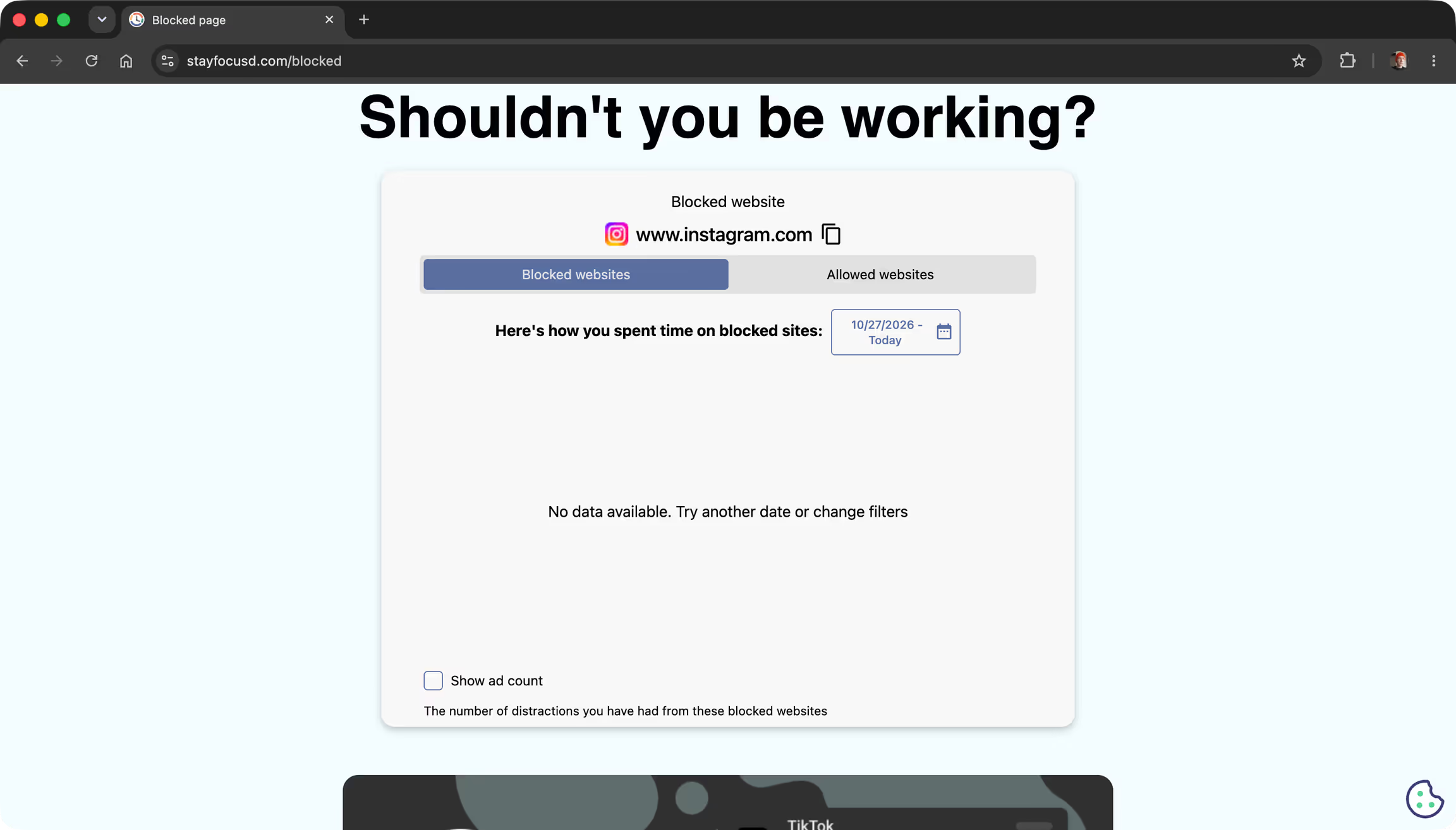
I started by capping my Twitter time at 30 minutes per day. Pretty quickly I found out that the extension couldn’t sync across devices, so with my second PC I was able to slack for an hour a day. After a few days I lowered the limit to 15 minutes, which gave me a total of half an hour. And then they rolled out the sync so I was left with 15 minutes per day.
The cool thing about this extension is that tightening the rules is much easier than loosening them, so you cannot cheat and get more time today (any looser rules only apply starting the next day).
The only real hack I sometimes used was turning off the extension itself in the browser settings. Later I vibe-coded some custom installation script that prevents this.
Nowadays I either block a website completely or add it to the “15-minute” list — besides Twitter, I’ve added LinkedIn and Reddit to it. And yeah, it’s 15 minutes total for all the websites.
The trigger for blocking a website is my own frustration. Some website has sucked me in for two hours, after which I realized I didn’t really enjoy it or get anything valuable? Bam, onto the blocklist goes the motherfucker.
In-app blockings
The moment we all became so hooked on social media was the rise of infinite feeds. So my biggest enemies became the For You pages, Recommended columns, Shorts, TikToks and Reels.
Luckily people have developed other extensions that allow you to block certain content inside websites.
I’ve blocked Twitter’s For You tab so I can only see the posts from the people I follow. Now every day I get this nostalgic feeling when you have scrolled to the end — to the posts you already saw yesterday. Like the old internet!
I’ve blocked YouTube recommendations from both the main page and the right side of the video player. Now I cannot open YouTube without a second thought — I only visit it with intention, because I have to either type something in the search box or check the new videos on the channels I follow.
My last enemy in this battle was Instagram Reels. I post regularly on Instagram so I need the app, and their web version makes me want to shoot myself in the head.
Instagram already has the “Following” tab which disables all the recommendations. But of course their incentive is to hide this tab from you, and if you do switch to it, to move you back at the first opportunity.
(As a programmer, I know it’s always super easy to hide intentional behavior behind technical peculiarities — say it’s just a bug, or reset the switch on app update under the guise of “incompatible data model changes”.)
Help came from an unexpected direction. The Dutch government forced Instagram to have the Following tab easily reachable, and (more importantly) to always preserve the user’s selection. And suddenly all the IT problems were solved and it has worked like a Swiss watch for almost a year now.
And again: you don’t have to enforce all the restrictions all at once. You can’t start a new life on Monday, and there’s no shortcut to success. This approach can take weeks and months, but I believe that’s the only method that really works.
And the result? I’m super happy and content. In a world where everybody complains they have no time, it turned out that there is actually a lot of time in a day, and spending it on what’s important to you feels really fulfilling.
The Big Illusion
Social media developers are smart and sneaky. They consult with the best researchers of human psychology, and those people know how to hook you.
What they mostly specialize in is the creation of The Big Illusion. This illusion tells you that if you quit the app, you’ll miss something important and valuable, and will be left behind. Because you get shots of pleasure (and sometimes a lot of other feelings) every time you use the apps, quitting them feels like you’re depriving yourself of something good and exciting. Your brain doesn’t like that so it makes up a lot of rationalizations for its addictive behavior.
When you’re withdrawing from social media, at first you experience strong FOMO. Your inner voice rebels:
I read the news every day, and after quitting I won’t know what happens in the world! I won’t be up to speed on the latest memes/trends/rumors/etc! I won’t know about the life of this celebrity I follow anymore! OH MY GOD. NO.
Once a couple of weeks pass, you realize that was The Big Illusion. You didn’t really miss anything important. It was all just unnecessary noise.
Instead of being “in the loop”, you’re now focused on your own life way more than on someone else’s.
Try again
On my way to breaking completely free of social media, I’ve failed a lot. I turned off my extension dozens of times and then forgot to turn it back on. I watched my apps get deprecated and stop working. I found myself watching Instagram reels for 2 hours straight after waking up, again.
If you fail, you may think that the method doesn’t work. What actually happens is that you underestimate the ability of your brain to find its way to cheap dopamine.
What you need is just to make another attempt. And another one. And another one. Ideally you don’t blame yourself too much and focus on a) kicking off another attempt as soon as possible, b) figuring out why this one failed, and how you can improve your setup/process to be more successful next time.
 my